|
|
|
|
|
|
|
|
|
|
|
|
|
Ⅰ Development of a differentiation induction system of tissue and bone
marrow stem cells to muscle and nerve system cells |
|
|
|
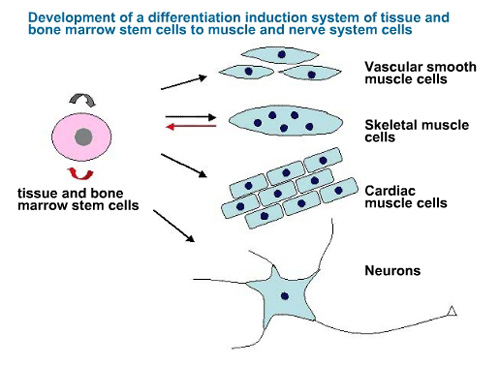
We aim to develop a differentiation induction system of tissue and
bone marrow stem cells to muscle system cells such as skeletal muscle,
cardiac muscle, and vascular smooth muscle cells and nerve system cells.
For severe diseases associated with muscle system cells such as myodystrophy,
myocardial infarction, and obstructive angiopathy and peripheral nervous
diseases such as spinal injury and neurogenic bladder, development of therapy
by cell transplantation 4 corresponding to each disease is expected to
be an urgent and important study subject. Particularly, transplantation
of auto-stem cells is the best mean for overcoming immunological disorders.
However, at present, it is difficult to specify differentiation to the
target cells because of pluripotency of stem cells. In this study, we address
this problem, aiming at development of a differentiation induction system
of muscle and nervous system cells.
We will also develop a differentiation induction system, in which blastogenesis of differentiated cells is induced, and the cells are then induced to re-differentiate into cells of the original or different lineage. For example, blastogenesis of myotubes will be induced (differentiated skeletal muscle cells fuse and form mature myotubes, and become the smallest dynamogenic unit of muscle fibers), and after a sufficient number of cells is acquired by promotion of cell proliferation, re-differentiation into skeletal muscle cells, cardiac muscle cells, vascular smooth muscle cells, and neurons will be induced. Development of this system is expected for application of cell differentiation of not only the cell lineages described above but also other cell lineages, and it may greatly contribute to regenerative medicine. |
|
|
 |
|
|
|
|
|
|
|
|
|
|
|
|
|
|
|
|
Ⅱ Study of signal transmission and gene expression mechanisms determining
differentiation of muscle and nerve system cells |
|
|
|
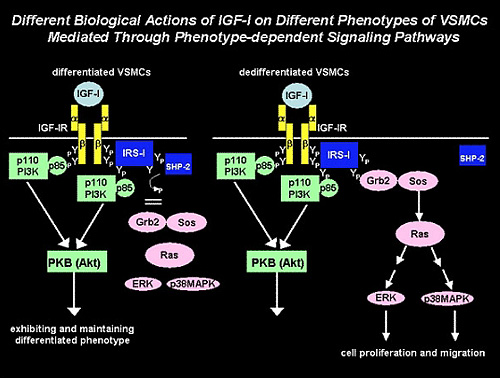
We have studied intracellular signaling of muscle system cells, particularly
vascular smooth muscle cells and skeletal muscle cells, and their downstream
gene expression apparatuses (transcription systems). The study, ‘development
of a differentiation induction system of tissue and bone marrow stem cells
into muscle and nervous system cells’, was planned and designed based
on these study results and experience. Thus, in this study, we aim at elucidation
of the intracellular signal transduction system and gene expression control
mechanism that determine differentiation of muscle and nervous system cells.
Particularly, we are planning to investigate involvement of the PI3 kinase/PKB
system and the relationship between this system and the downstream transcriptional
apparatus consisting of homeo transcriptional factor, SRF, and GATA transcriptional
factor with regard to muscle system cell differentiation, and master genes
of vascular smooth muscle and cardiac muscle cell differentiation. |
|
|
 |
|
|
|
|
|
|
|
|
|
|
|
|
|
|
|
|
|
|
|
Ⅲ Molecular control mechanism of synapse plasticity |
|
|
|
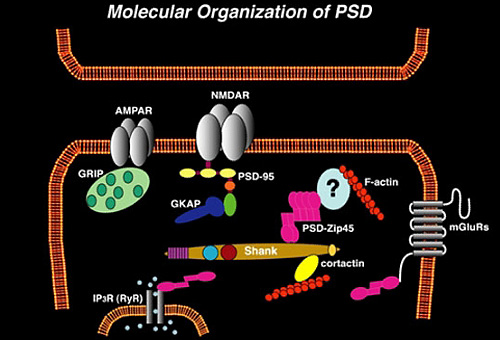
Synapses are adhesion devices differentiated to perform inter-neuronal
information transmission. Synapse formation and synapses once formed show
plasticity (formation, regression, and dynamics) dependent on nerve activities.
We have searched for a series of major constituent proteins that form synapses
(PSD proteins). We aim to investigate the roles of these PSD proteins in,
and control mechanisms of, synapse plasticity and to clarify the etiology
of psychiatric and neurological disorders due to disruption of the control
system. |
|
|
 |
|
|
|
|
|
|
Other study contents of Sobue laboratory |
|
|
|
|
■Study of signal transmission determining differentiation and dedifferentiated
phenotypes of vascular smooth muscle cells, and gene expression control
mechanism
■Study of the molecular mechanism of development of arteriosclerosis
■Study of the molecular mechanism of synapse plasticity
■Study to determine cell membrane structure biology |
|
|
|
|
Sobue associated page≫ |
|
|
|
|
|
|
|
|
|


