|
|
|
|
|
|
|
|
|
|
|
|
Ⅰ What are stem cells? |
|
|
|
Stem cells are undifferentiated cells with self-renewal ability and
differentiation potential. Stem cells can differentiate into functional
cells through intermediated progenitor cells. Cells with a short life span,
such as blood cells,epithelial cells of skin and intestinal mucosa, are
not depleted during the lifetime, because stem cells continuously generate
those cells. It has recently been clarified that stem cells are present
in tissues that were once considered not to regenerate, such as nerves
and skeletal muscle. Thus, in a sense, our bodies are a “stem cell world”
consisting of many stem cell systems. Stem cells are rapidly acquiring
recognition that stem cells should be useful for regenerative medicine
with the greatest expectation. For this purpose, stem cells should be expanded
out of the body (ex vivo) and then will be used for cell transplantation.
Our research is aimed to solve the problems underlying the stem cell systems.
One is a basic research concerning how the stem cell are developed and
maintained. The other is an application-oriented research, i.e., the development
development of stem cell manipulation method for the use in regenerative
medicine. |
|
|
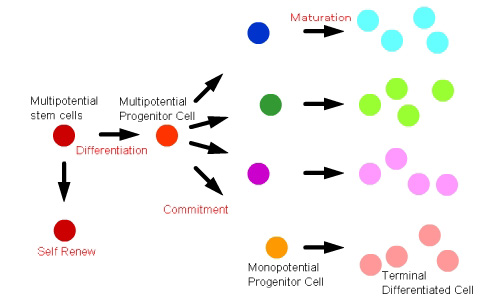
Stem Cell System |
|
|
 |
|
|
■Stem cells possess self-renewing activity and differentiation ability.
■Stem cells are differentiated to the functional cells through progenitor cells. |
|
|
|
|
|
|
|
|
|
|
|
|
|
Ⅱ Differentiation induction of ES cells into blood cells |
|
|
|
In addition to tissue stem cells (also known as organ stem cells or
adult stem cells), there exist embryonic stem (ES) cells established from
early embryos. Once mouse ES cells are re-introduced to the early embryo,
they are incorporated into the normal development process and can differentiate
into all cells including germ cells. Thus, ES cells are pluripotent (or
almost totipotent) in differentiation. Their differentiation potential
is considerably restricted in vitro compared that of in vivo. However,
their differentiation into blood cells, vascular endothelial cells, myocardial
cells, and neurons can be induced easily and feasibly. We have developed
a method to induce differentiation of mouse ES cells into blood cells by
culturing them on stroma cells (OP9 system) and are studying molecular
mechanisms of blood cell differentiation for their future application to
regenerative medicine. |
|
|
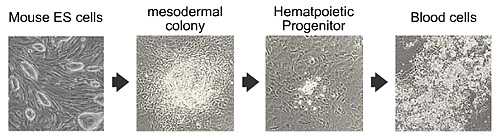
In vitro Differentiation from ES cells to Blood cells |
|
|
 |
|
|
■Co-culturing mouse ES cells on OP9 cells gives rise to functional blood
cells,
via mesodermal colony and hematopoietic progenitor cells.
■The “OP9 system” can be combined with various genetic manipulation.
■Molecular mechanisms of hematopoietic development and differentiation
can be analyzed by the use of OP9 system and genetic manipulation. |
|
|
|
|
|
|
|
|
|
|
|
|
|
Ⅲ Mechanisms of germ cell and stem cell development |
|
|
|
The cells in our body can be classified into two categories, germ cells
and somatic cells. Only the germ cells can transmit genetic information
generation to generation. Germ line cells are separated from somatic cells
in an early stage of embryogenesis. Primordial germ cells, which appear
first in the process of germ cell differentiation, are already destined
for the germ line, but they can be de-differentiated into embryonic germ
(EG) cells, which are pluripotent cells with properties nearly identical
to those of ES cells, under specific culturing conditions. We are studying
how germ line cells are commited and how germ line cells re-acquire pluripotency.
Through this study, we are also evaluating what molecular mechanisms endue
the pluripotency.
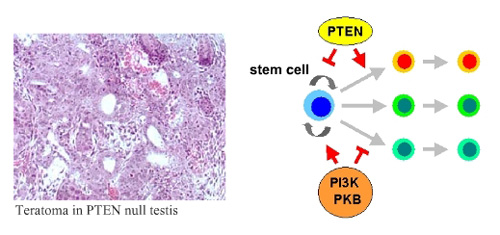
Based on the analysis of the mouse lacking a tumor suppressor gene
PTEN, the signal of PTEN/PI3 kinase turn out to play crucial roles to maintain
the undifferentiated state of stem cells. We are studying the function
of PTEN/PI3 kinase for the “stemness” and developing a method for stem
cell regulation by means of signal manipulation. |
|
|
Molecular Mechanisms for Germ Cell Development |
|
|
 |
|
|
■Null mutation of a tumor suppressor gene PTEN de-differentiate germ cells
to pluripotent stem cells.
■PTEN/PI3kinase signal plays crucial roles in stem cell maintenance. |
|
|
|
Other study contents of Nakano laboratory |
|
|
|
|
■Functional analysis of PGC7/Stella in establishment of germ cells
■Yesterday analysis of mammalian Piwi family genes |
|
|
|
|
Nakano associated page≫ |
|
|
|
|
|
|
|


