|
|
|
|
|
|
|
|
|
|
|
|
|
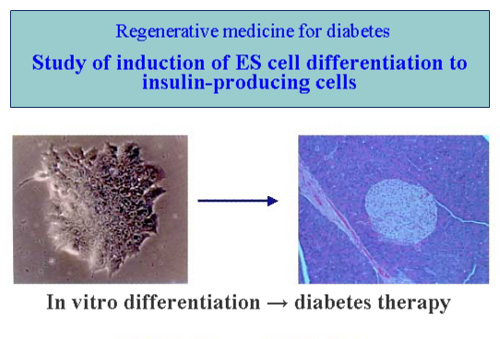
Ⅰ Induction of differentiation of ES cells to insulin-producing cells |
|
|
|
Diabetes occurs due to relative or absolute insufficiency of insulin
that decreases blood glucose. Transplantation of the pancreas or pancreatic
islets is a radical therapeutic method, but lack of donors is a problem.
Accordingly, studies of β cell regeneration raises great expectation.
Several groups have recently succeeded in differentiation of mouse ES cells
to insulin-producing cells. Various attempts have also been performed to
increase the differentiation efficiency, suggesting that, for efficient
induction of differentiation to insulin-producing cells (β cells), which
are functionally highly differentiated, introduction of a new method is
necessary, as opposed to the modification of culture conditions or addition
of growth factors which are currently performed.
In this study, we will introduce genes of transcriptional factors considered
to be related to the differentiation of β cells in a manner that allows
inducible of expression of the genes, and the gene expression will be induced
in the differentiation induction process in attempt to efficiently induce
differentiation of β cells.
For cell transplantation, efficient separation of β cells from ES cells
is necessary. For this purpose, we will establish a β cell purification
method, in which a drug-resistance or reporter gene will be inserted into
ES cells beforehand so as to specifically express the gene only in β cells,
and the cells will be selected using the drug or reporter after induction
of differentiation. Furthermore, we will study differentiation of human
ES cells to β cells based on the results of the above studies. |
|
|
 |
|
|
|
|
|
|
|
|
|
|
|
|
|
|
|
|
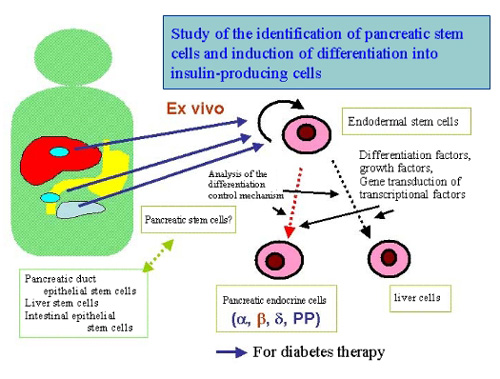
Ⅱ Identification of pancreatic stem cells and induction of differentiation
to insulin-producing cells |
|
|
|
It has recently been reported that pancreatic β cells have some proliferative
ability. However, at present, it is difficult to proliferate β cells in
vivo and in vitro. Partial excision of the pancreas and chronic destruction
of β cells induce pdx-1-positive cells in the pancreas, and these cells
may differentiate to β cells (pdx-1 is a transcriptional factor serving
as the master-switch of pancreatic differentiation).
We have shown that new insulin-secreting cells appeared in the pancreas when pdx-1 was expressed in mouse pancreas using adenovirus vectors, suggesting that tissue stem cells present in the pancreas differentiated to β cells. In addition, our recent investigation of cells isolated from the pancreatic duct epithelium has shown that expression of insulin and albumin could be induded by changing the culture conditions.
Therefore, these cells capable of differentiation into insulin-producing
cells are assumed to be tissue stem cells. In this study, we will try to
regenerate β cells using these tissue stem cells in the body. Since success
of this study enables regeneration of β cells from patients’ own cells,
the study is raising high hopes. |
|
|
 |
|
|
|
|
|
|
|
|
|
|
|
|
|
|
|
|
|
|
|
Ⅲ Elucidation of the mechanism of maintaining the undifferentiated
state of ES cells |
|
|
|
Regenerative medicine utilizing pluripotency of embryonic stem (ES) cells in in-vitro differentiation is raising high hopes. However, study of ES cells, that is how its totipotency or pluripotency is maintained, has not made much progress.
This mechanism may be closely related to the re-programming mechanism of
cloned embryos and the pluripotency maintenance mechanism of tissue stem
cells, and thus, it is an important subject in embryology. The aim of this
study is identification and analysis of novel genes involved in the maintenance
of pluripotency and totipotency.
The database of cDNA specific to the embryonic stage and EST sequence has
been enriched, and we will select candidate genes using the information.
For the candidate genes, genes expressed only in cells considered to maintain
totipotency and pluripotency. Particularly, 3 types of genes: genes specifically
expressed in ES cells, genes expressed in unfertilized oocyte stage in
the maturation process, expression of which decreases upon fertilization,
and genes persistently expressed only in germ cell lineages.
After confirmation of expression of these genes in ES cells and the early
embryos, we will analyze their functions mainly using gene knockout technique,
and clarify the molecular mechanism related to maintenance of the undifferentiated
state. |
|
|
|
|
|
|
|
|
|
Other study contents of Kanakura laboratory |
|
|
|
|
■Study of nuclear receptor function in pancreatic β cells
|
|
|
|
|
Miyazaki associated page≫ |
|
|
|
|
|
|
|
|
|


