|
|
|
|
|
|
|
|
|
|
|
|
|
Ⅰ A new therapeutic strategy to obtain a bridge to recovery in patients
with severe heart failure |
|
|
|
We have made great efforts to develop therapeutic strategies against
severe heart failure and constructed systems of heart transplantation in
and out of the hospital. Since we performed the first heart transplantation
after the introduction of the law, we have always led Japanese facilities
in such achievements. In the field of assisted circulation, we have succeeded
in supporting patients for periods that exceeded the world standard for
treatment, so providing a bridge to transplantation, and even a bridge
to recovery in some patients from conditions that are indications of heart
transplantation (recovery of cardiac function).
In addition to these replacement type therapies, we have recently concentrated
our efforts to develop new regenerative therapies, and made preparations
for their clinical applications. Recently, regenerative therapies that
have been attempted for various organ failures are attracting attention
as possible treatments for severe heart failure. Among regenerative therapies
for the heart muscle, transplantation of cells such as myoblasts into the
heart muscle has been reported clinically to improve cardiac function.
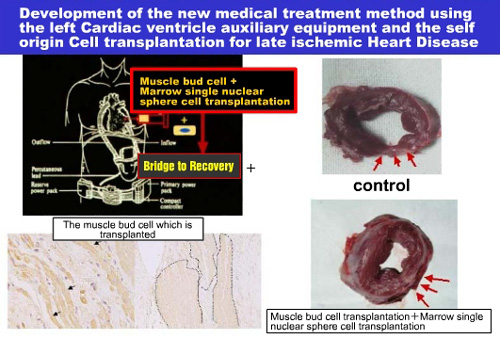
We have started a clinical study on heart muscle regeneration in patients
with severer ischemic cardiomyopathy by transplantation of skeletal myoblasts
and bone marrow monocytes. |
|
|
 |
|
|
|
|
|
 |
|
|
|
|
|
 |
|
|
|
|
|
|
|
|
|
|
|
|
|
Ⅱ Myocardial regenerative therapy using cell sheets |
|
|
|
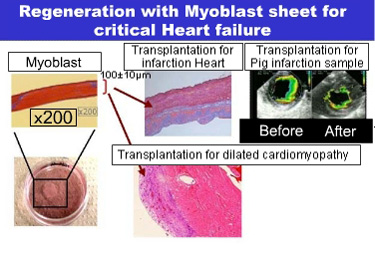
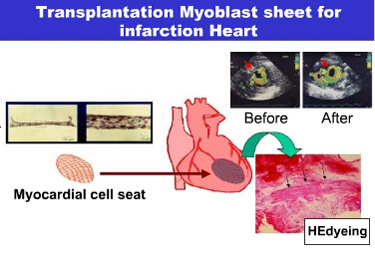
We have endeavored to develop myocardial regenerative therapy using
cell sheets by tissue engineering technology, and transplanted cell sheets
to rat models of myocardial infarction and hamsters with cardiomyopathy
showing heart failure. Cell sheets have been histologically assimilated
with the damaged hearts, improved cardiac function, and prolonged the recipients’
survival periods. Presently,
autologous skeletal myoblasts are considered ethically and quantitatively to be appropriate as a source of cells, and a pre-clinical study on the usefulness of myoblast sheets for myocardial regeneration in large animals is in progress. Such myocardial regenerative therapies using cell transplantation and tissue engineering are expected to develop as new strategies of surgical treatment depending on the disease and the severity, or as an alternative for replacement type therapies. |
|
|
 |
|
|
|
|
|
|
|
|
|
|
|
|
|
|
|
|
Ⅲ Development of an intelligent implant device for myocardial regeneration
prepared by stem cell induction |
|
|
|
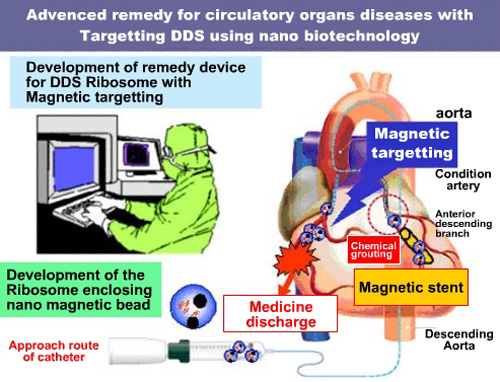
Medicine-engineering cooperation in which recent engineering techniques
such as biomaterials are combined with medical techniques is rapidly progressing,
and clinical application of new techniques developed by medicine-engineering
cooperation is expected. A perspective of clinical needs is considered
to be particularly important for the development of new techniques by medicine-engineering
cooperation. Therefore, it is important to discuss medicine-engineering
cooperation with the aim of developing advanced high-tech medicine, particularly
regenerative medicine, and promoting its industrialization with emphasis
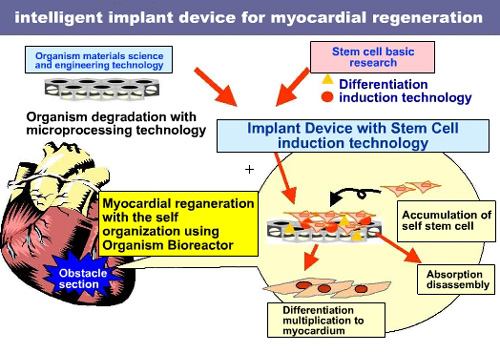
on the endpoint. We regard this concept as the basis of this COE. Therefore,
the development of an intelligent implant device for myocardial regeneration
by the extensive use of techniques derived from fusion of biomaterial science
and stem cell science for regenerative medicine, which makes cell culturing
unnecessary, is considered to be a final goal for realization of regenerative
therapy, with regard to emergency readiness, morality, commercial potential,
and ease of clinical trial. |
|
|
 |
|
|
|
|
|
|
Other study contents of Matsuda / Sawa laboratory |
|
|
|
|
■Gene therapy in the circulatory field
■Development of a non-cell biological valve by tissue engineering
■Basic study of reperfusion of myocardial ischemia and the development
of a new myocardial protection method
■Elucidation of the development mechanism of cardiac hypertrophy and development
of a therapy
■Development of biodegradable artificial blood vessels by biomaterial
engineering
■Development of low-invasive cardiac surgery: robot-assisted heart surgery
■Support and promotion of translational research at the Medical Center
for Translational Research |
|
|
|
|
Matsuda / Sawa associated page≫ |
|
|
|
|
|
|
|
|
|


