|
|
|
|
|
|
|
|
|
|
|
|
|
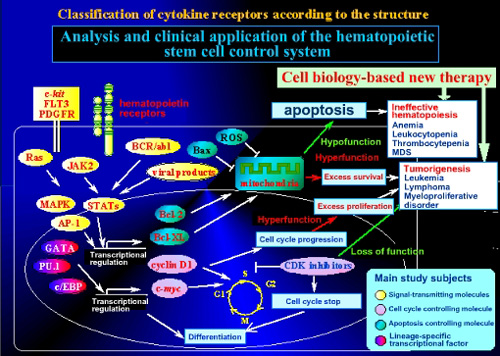
Ⅰ Analysis and clinical application of the hematopoietic stem cell
control system |
|
|
|
We aim at elucidation of the proliferation, differentiation, and survival
mechanism of hematopoietic cells at a molecular level and its application
for treatment of various intractable diseases. We will perform analysis
of the factors below to elucidate the amplification, proliferation, and
differentiation mechanisms, and develop a hematopoietic cell control method.
- Functional analysis of signal-transmitting molecules in cytokine-induced proliferation and differentiation of hematopoietic cells and BCR/ABL oncogenes
- Analysis of the molecular mechanism of the cell cycle in the developmental
process (proliferation and differentiation) of blood cells and the self-replication
and resting stages of hematopoietic cells
- Analysis of apoptosis-regulating molecules including Bcl-2 in the survival
and death of hematopoietic cells and the role of redox control |
|
|
 |
|
|
|
|
|
|
|
|
|
|
|
|
|
|
|
|
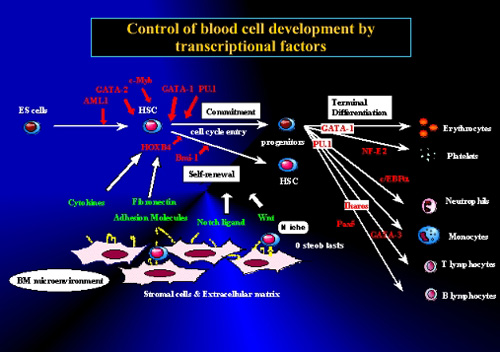
Ⅱ Developmental control of blood cells by transcriptional factors |
|
|
|
We will perform functional analysis of Notch in maintenance of the
undifferentiated state of hematopoietic cells, and functional analysis
of lineage-specific transcriptional factors such as GATA-1 and PU.1. Applying
these results, we will attempt in vitro amplification of hematopoietic
stem cells by gene transduction, induction of differentiation of blood
cells of a specific lineage, and mass production of blood cells from ES
cells.。 |
|
|
 |
|
|
|
|
|
|
|
|
|
|
|
|
|
|
|
|
|
|
|
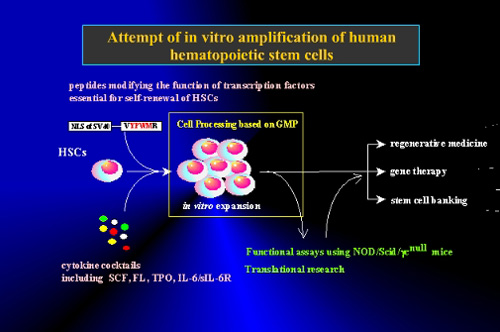
Ⅲ An attempt at in vitro proliferation of human hematopoietic stem cells |
|
|
|
Attention has been directed to cord blood as a cell source for hematopoietic stem cell (HSC) transplantation. We synthesize peptides that modify various signals and transcription, introduce them into human cord blood HSCs, make them proliferate in vitro, and analyze their functions.
Specifically, we perform the analysis using a decoy peptide of HOX transcription factors, which are known to be self-replicating factors of HSCs. HOX forms hetero complexes with PBX1, which is a homeobox type transcription factor as is HOX, and regulates the expression of various genes as on or off. In the process of self-replication of HSCs, PBX1 has been reported to regulate the HOXB4 activity as off and the activity of HOXA10, which is another gene of the HOX family, as on. We, therefore, design and synthesize a decoy peptide of HOX protein in the binding region for PBX1 that can alter the activity of endogenous HOX/PBX1 complexes,
introduce it into human cord blood HSCs, and evaluate the effects of the
decoy peptide on the self-replication ability and pluripotential of HSCs.
When we introduced a decoy peptide, fluorescence-labeled at the terminal,
into CD34-positive HSCs isolated from cord blood by the magnetic beads
method, the introduction efficiency of this synthetic peptide into HSCs
was higher than that of genes, and no effect was observed in the chromosomes
of the cells into which the peptide was introduced. Therefore, this method
is considered to be effective for extracorporeal proliferation of HSCs.
|
|
|
 |
|
|
|
|
|
|
Other study contents of Kanakura laboratory |
|
|
|
|
■Analysis of hematopoietic tumor pathology and the development of therapy
■Analysis and application of the lymphocyte support system
■Functional analysis of the novel anti-apoptotic molecule, Anamorsin
■Analysis of molecular mechanisms of thrombus and hemostasis
■Identification and pathological analysis of molecular abnormality in
platelet dysfunction
■Cause and pathology of paroxysmal nocturnal hemoglobinuria (PNH) |
|
|
|
|
Kanakura associated page≫ |
|
|
|
|
|
|
|
|
|


