|
|
|
|
|
|
|
|
|
|
|
|
|
Ⅰ Development and morphogenesis of the heart |
|
|
|
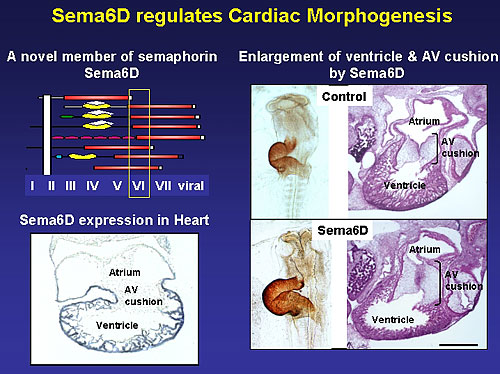
Cardiac muscle cells develop from the lateral regions of the mesoderm
in response to various differentiation and growth factors. Cardiac muscle
cells then migrate toward the median region, form a tubular structure,
and through repeated rotations and local fusions complete a mature heart
consisting of 4 cavities and 4 valves. However, factors involved in this
series of morphogenic processes have hardly been known.
We have analyzed functions of various factors involved in heart development
by suppressions using the RNAi method and over-expression using retroviruses
in chick embryos. As a result, we discovered that a new type of Semaphorin
molecule (Sema6D), known as an axon guidance factor, plays an important
role in early morphogenesis of the heart. We are presently preparing Sema6D-defect
mice for analysis of its role in mammals. In this COE, we will investigate
the relation between congenital abnormalities of the heart and mutations
of Sema6D. |
|
|
 |
|
|
|
|
|
|
|
|
|
|
|
|
|
|
|
|
Ⅱ Molecular mechanism of hypertrophy and cell death of cardiac muscle
cells |
|
|
|
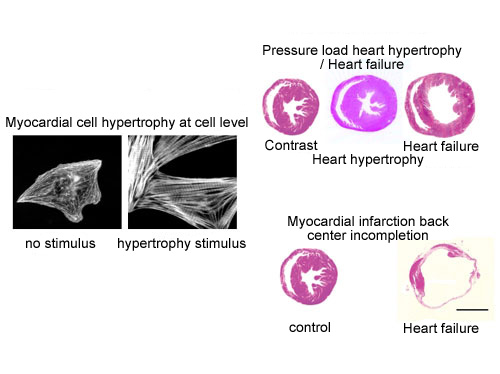
Cardiac muscle cell hypertrophy occurs to adapt to stress in all heart diseases such as myocardial infarction, cardiomyopathy, valvular disease, and hypertension, corresponding to the pressure and volume loads. However, when excess stress persists for a long time, cell death of cardiac muscle cells occurs, and the heart expands, resulting in heart failure.
In this study, we will clarify the molecular mechanism of hypertrophy and
death of cardiac muscle cells, identify the target molecules for treatment
of heart failure, and develop a novel therapy for heart failure.
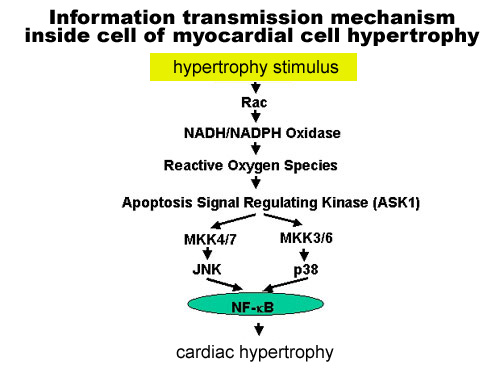
We have recently clarified that MAP kinases, particularly apoptosis signal-regulating
kinase (ASK1) related to apoptosis, play an important role in hypertrophy
and cell death of cardiac muscle cells because they are resistant in mice
with knockout-induced heart failure. In this study, we will investigate
whether ASK1 can be used as the target molecule in the treatment of heart
failure by introducing a mutant gene that inhibits activity of the enzyme
in the animal model of heart failure. In addition, we will identify substances
involved in cell death of cardiac muscle cells present downstream of ASK1
using proteomics and genomics techniques, and cell-biologically investigate
functions of the identified substances using genetically modified mice.
Based on the above, we will develop new drugs targeting molecules including
ASK1 that are involved in cell death of cardiac muscle cells and play an
important role in development of heart failure, aiming at clinical application. |
|
|
 |
|
|
|
|
|
 |
|
|
|
|
|
|
|
|
|
|
|
|
|
Ⅲ Control of the molecular system using photons |
|
|
|
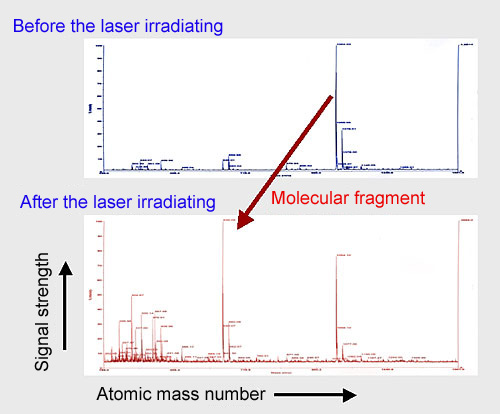
Short wavelength ultraviolet and visible lights easily causes irreversible
molecular degradation what we could see when fluorescence microscopic examination.
However, utilizing infrared light, has lower single photon energy, might
reduce non-specific molecular degradation. We have investigated how to
regulate molecular structure by the specific regulation of fragmentation
and activation of bio-molecules such as proteins or peptides, using the
specific infrared LASER beam which resonates with targeted chemical bonds.
In this COE project, we will endeavor to utilize this pin-pointed infrared
LASER irradiation technique for a substitution of enzyme mediated reaction,
regulation of physiologic activity, and drug delivery system combined with
techniques of peptide and protein medicine. Further investigations of LASER
molecular handling technique would bring us to a new life science era of
microscopic fabrication of cellular environment. |
|
|
 |
|
|
|
|
|
|
Other study contents of Hori laboratory |
|
|
|
|
■Elucidation of the development mechanism of tissue damage and organ failure
and establishment of a diagnostic and therapeutic strategy
■Elucidation of the molecular mechanism of ischemic responses in the heart
and brain and study of the induction of an artificial ischemia-resistant
response
■Large-scale study of the relationship between diabetes and arteriosclerosis
■Large-scale study and intervention study of the relationship between
atrial fibrillation and arteriosclerosis
■Large-scale epidemiological survey and intervention study of myocardial
infarction
■Analysis of genes related to diseases |
|
|
|
|
Hori associated page≫ |
|
|
|
|
|
|
|
|
|


