|
|
|
|
|
|
|
 |
|
|
|
|
|
|
|
|
|
|
|
|
|
Ⅰ Mass spectrometry of biological tissues by
UV/FEL-MALDI method |
|
|
|
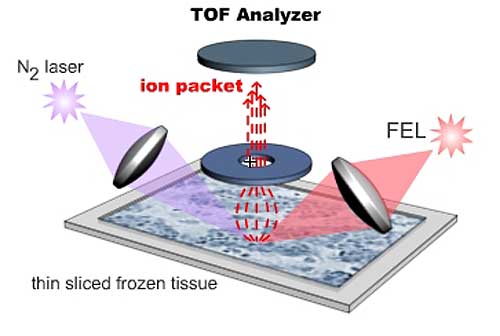
Laser soft ionization of protein, matrix-assisted laser desorption ionization (MALDI), is a technique that has accelerated the progress of proteomics by mass spectrometry. However, ionization using ultraviolet lasers, which is currently used widely, is incapable of analyzing complex mixtures of insoluble proteins and lipids consist of cell membranes and biological tissues. UV/FEL-MALDI mass spectrometry system for analysis of insoluble proteins developed by our laboratory has achieved ionization of insoluble proteins in a mixed environment with irradiation by 2 types of laser: an ultraviolet laser and a tunable mid infrared free electron laser (MIR-FEL). In this COE, we will study the realization of efficient laser ionization using this method, and MALDI mass spectrometry at the cell and tissue level, which has not yet been achieved. We will also try to develop the system for cell and tissue analysis.
Concretely, the following are considered.
■UV/FEL-MALDI mass spectrometry of complex
■In-situ MALDI mass spectrometry and mass imaging of cells and tissues
■Breakthrough of the ionization mechanism of UV/FEL-MALDI and achievement
of very high efficiency of ionization |
|
|
<Direct Proteome Profiling / Mass spectroscopy of biological tissues by
MALDI method> |
|
|
 |
|
|
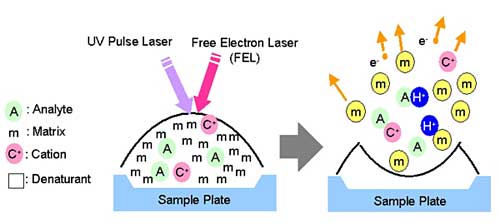
<Ionization of UV/FEL-MALDI method> |
|
|
 |
|
|
|
Targets (mixture of sample, matrix, and denaturant) are simultaneously
irradiated with an UV pulse laser and a mid infrared free electron laser
(MIR-FEL). The UV laser induces an excited state in the electrons, and
rapidly superheats the matrix, inducing proton donating-receiving reactions
upon evaporation. MIR-FEL induces a vibrational excited state and assists
ionization by weakening the aggregating action of the solubilizer that
inhibits the ionization process. |
|
|
|
|
|
|
|
|
|
|
|
|
|
|
|
|
|
Ⅱ Development of an on-chip cell culture management system using light |
|
|
|
Currently, the quality and function of cells and tissues are evaluated
using direct destructive methods such as biochemical techniques. Moreover,
limited amounts of cells and tissues are available for transplantation
in regenerative medicine. Thus, development of a screening technique capable
of performing nondestructive rapid functional evaluation and quality control
is necessary. We performs quality control of cells and soft and hard tissues,
mainly ES cells, stem cells, regenerated tissues, and regenerated bone
studied in this COE, using photochemical methods, mainly laser fluorescence
excitation and infrared spectroscopy, aiming at the establishment of a
novel method of evaluating the functions of cells and tissues. For recovery
of cells of interest after analysis of cell types and functions, currently
large and expensive instruments such as flow cytometers and cell sorters
are necessary. Downsizing and generalization of the cell sorting technique
is necessary for the clinical application (generalization) of cell studies.
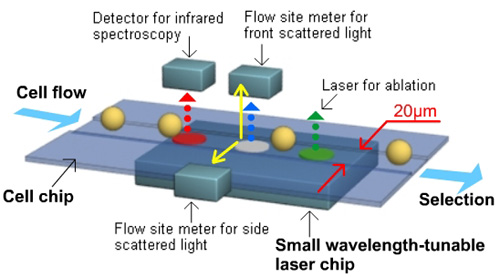
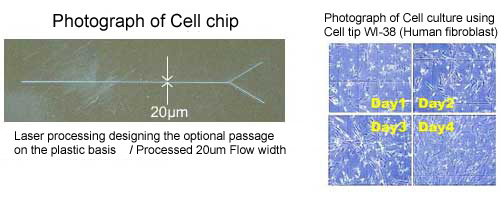
Thus, we will develop a 'cell chip', on which quality control of cells
can be performed eg. cell culture ⇒ measurement ⇒ sorting (improvement
of quality) ⇒ recovery. Cell chips aim at advancement in culture capacity,
simplification of measurement and control, and high recovery efficiency
for construction of an integrative cell culture management system. |
|
|
<The image of cell quality controle with Laser cell tip> |
|
|
 |
|
|
|
|
|
 |
|
|
Cell chips that allow the culture, measurement, selection, and sorting of cells on chips
will be developed, and quality of cells will be controlled using the cell chips.
Measurement and selection of cells will be controlled
using quantum beams (laser, light, etc.). |
|
|
|
|
|
|
|
|
|
|
|
|
|
|
|
|
|
|
|
Ⅲ The non-destructive measurement method of phosphorylation using infrared
spectroscopy, and the affinity control by laser-dephosphorylation |
|
|
|
For reconstruction of tissues located in the boundary between hard
and soft tissues such as tendons, intervertebral discs, and periodontal
tissues, material techniques capable of accurate control of compatibility
with soft tissues and adherence to hard tissues are necessary. Regarding
biocompatibility and adherence, it has been reported that bases possessing
phosphate groups promote formation of hydroxyapatite, the main component
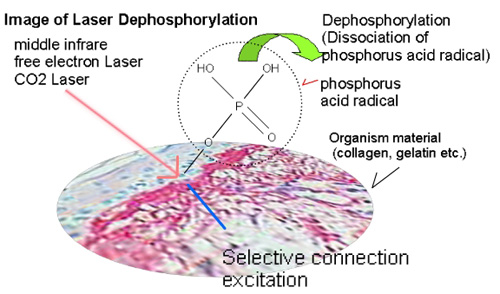
of hard tissues. Our laboratory is performing a development study of non-contact
and nondestructive methods of protein phosphorylation using infrared spectroscopy
and laser dephosphorylation method using free electron laser in the 9μm
wavelength zone and CO2 laser. The laser dephosphorylation methods will
control the phosphorylation level on biomaterial surfaces, and the surface
phosphorylation level will be measured with no contact using infrared spectroscopy
to achieve desired adherence and compatibility of biomaterials for optimization
of biomaterial designs. |
|
|
|
|
|
 |
|
|
In this COE program, we make efforts to develop researchers capable of highly understanding and studying the 2 fields, engineering, and medicine. |
|
|
|
Other study contents of Awazu laboratory |
|
|
|
|
■Development of novel laser angioplasty for atherosclerosis therapy by
selective removal of cholesterol
■Development of hollow optical fiber system for guiding light in the body
cavity
■Removal of new blood vessels by ICG-PDT using femtosecond laser
■Development of DDS using laser percutaneous absorption
■Infrared spectroscopic analysis of phosphorylation and laser dephosphorylation
■Prevention of dental caries by improvement of surface quality of tooth
hard tissue
■Development of real-time monitoring method using laser-induced sound
■Elucidation of the biological soft tissue excision mechanism for low-invasive
laser surgery |
|
|
|
|
Awazu associated page1≫
Awazu associated page2≫ |
|
|
|
|
|
|
|
|
|


